MapReduce执行流程源码深度剖析(三)
1.MapTask的工作原理1.1 runNewMapperprivate <INKEY,INVALUE,OUTKEY,OUTVALUE>void runNewMapper(final JobConf job,final TaskSplitIndex splitIndex,final TaskUmbilicalProtocol umbilical,TaskReporter
·
1. MapTask的工作原理
1.1 runNewMapper
private <INKEY,INVALUE,OUTKEY,OUTVALUE>
void runNewMapper(final JobConf job,
                  final TaskSplitIndex splitIndex,
                  final TaskUmbilicalProtocol umbilical,
                  TaskReporter reporter
                  ) throws IOException, ClassNotFoundException,
                           InterruptedException {
  // make a task context so we can get the classes
  /**
   * TODO
   *  每个MapTask都会有一个 TaskContext的上下文对象
   *  job.setXXX() 设置的各种组件,都放置在这个taskContext对象里面
   */
  org.apache.hadoop.mapreduce.TaskAttemptContext taskContext =
    new org.apache.hadoop.mapreduce.task.TaskAttemptContextImpl(job,
                                                                getTaskID(),
                                                                reporter);
  // make a mapper
  /**
   * TODO make a maper
   *  就是自己定义的mapper组件的实例对象
   */
  org.apache.hadoop.mapreduce.Mapper<INKEY,INVALUE,OUTKEY,OUTVALUE> mapper =
    (org.apache.hadoop.mapreduce.Mapper<INKEY,INVALUE,OUTKEY,OUTVALUE>)
            //TODO 通过反射的形式来进行构建的
      ReflectionUtils.newInstance(taskContext.getMapperClass(), job);
  // make the input format
  org.apache.hadoop.mapreduce.InputFormat<INKEY,INVALUE> inputFormat =
    (org.apache.hadoop.mapreduce.InputFormat<INKEY,INVALUE>)
            //TODO 构建一个输入组件, 默认是TextInputFormat.class
      ReflectionUtils.newInstance(taskContext.getInputFormatClass(), job);
  // rebuild the input split
  //TODO 先进行逻辑切片,每个逻辑切片,其实就是一个InputSplit对象
  //TODO 每个 逻辑切片启动一个MapTask
  org.apache.hadoop.mapreduce.InputSplit split = null;
  split = getSplitDetails(new Path(splitIndex.getSplitLocation()),
      splitIndex.getStartOffset());
  LOG.info("Processing split: " + split);

  /**
   * TODO
   *  正常来说,应该是由InputFormat来定义输入的格式
   *  具体的输入工作由RecordReader来做,  RecorReader 就是inputFormat的衍生组件 (组合设计模式)
   *  RecordReader 是由 InputFormat 来创建和关闭的!
   */
  org.apache.hadoop.mapreduce.RecordReader<INKEY,INVALUE> input = new NewTrackingRecordReader<INKEY,INVALUE>
      (split, inputFormat, reporter, taskContext);

  job.setBoolean(JobContext.SKIP_RECORDS, isSkipping());
  /**
   * TODO RecordWriter 负责数据写出
   */
  org.apache.hadoop.mapreduce.RecordWriter output = null;

  // get an output object
  /**
   * 如果没有 reducetask 那么就走 NewDirectOutputCollector
   * 如果有 reducetask   那么就走 NewOutputCollector
   */
  if (job.getNumReduceTasks() == 0) {
    output =
      new NewDirectOutputCollector(taskContext, job, umbilical, reporter);
  } else {
    //TODO  默认走这里
    // 如果没有reducer直接写出,这里准备了MapBuffer 也就是环形缓冲区
    /**
     * TODO
     *  context.write()
     *  output.collect()
     */
    output = new NewOutputCollector(taskContext, job, umbilical, reporter);
  }

  /**
   * TODO MapContext 初始化 其实就是传播了很多的信息 来进行让其他的组件也能看到
   * mapper.run(context) 中context 具备四个方法,其实就是调用了mapperContext的四个方法
   */
  org.apache.hadoop.mapreduce.MapContext<INKEY, INVALUE, OUTKEY, OUTVALUE> mapContext =
    new MapContextImpl<INKEY, INVALUE, OUTKEY, OUTVALUE>(job, getTaskID(),
        input, output,
        committer,
        reporter, split);

  //装饰者设计模式.就是 把 mapContext 包装了一下
  /**
   * mapper.run(context) 中context 具备四个方法,其实也就是调用了 mapperContext的四个方法
   * 其实就是调用了 mapContext的四个同名方法
   */
  org.apache.hadoop.mapreduce.Mapper<INKEY,INVALUE,OUTKEY,OUTVALUE>.Context
      mapperContext =
        new WrappedMapper<INKEY, INVALUE, OUTKEY, OUTVALUE>().getMapContext(
            mapContext);

  try {
    /**
     * TODO 访问数据源,如果是文件,提前创建好读取该文件的输入流
     * TODO 构建了逐行读取器
     * input = LineRecordReader
     * 这里又是采用了包装,我发现 设计中 用包装比较好,
     * 最重要的事情,就是根据OutputFormat创建了一个RecordReader
     * real = LineRecordReader
     */
    input.initialize(split, mapperContext);
    //TODO map开始执行,其实就是我们自己写的程序的Mapper实例对象

    mapper.run
            (mapperContext);
    mapPhase.complete();
    setPhase(TaskStatus.Phase.SORT);
    statusUpdate(umbilical);
    input.close();
    input = null;
    /**
     * TODO 执行合并 spill的操作
     *
     */
    output.close(mapperContext);
    output = null;
  } finally {
    closeQuietly(input);
    closeQuietly(output, mapperContext);
  }
}
1.2 mapper.run(mapperContext)
/**
   * Expert users can override this method for more complete control over the
   * execution of the Mapper.
   * @param context
   * @throws IOException
   * mapper组件中 都有用一个 context
   */
  public void run(Context context) throws IOException, InterruptedException {
    //一般用来做初始化,默认实现什么都没做
    setup(context);
    try {
      /**
       * TODO nextkeyvalue() 取一个keyvalue 表示当前防范能取到值吗
       * mapper组件中,都有一个叫做 context的参数 这个参数拥有最重要的四个方法:
       * 1.context.nextKeyValue()
       * 2.context.getCurrentKey()
       * 3.context.getCurrentValue()
       * 4.context.write()
       *
       * context  对象中 包含了真正去读取数据 和输出数据的对象实例
       * 这里就是典型的装饰器设计模式的体现
       */
      while (context.nextKeyValue()) {
        map(context.getCurrentKey(), context.getCurrentValue(), context);
      }
    } finally {
      // 一般用来做收尾操作
      cleanup(context);
    }
  }
}
1.3 map
/**
 * Called once for each key/value pair in the input split. Most applications
 * should override this, but the default is the identity function.
 */
@SuppressWarnings("unchecked")
protected void map(KEYIN key, VALUEIN value,
                   Context context) throws IOException, InterruptedException {
  context.write((KEYOUT) key, (VALUEOUT) value);
}
1.4 真正执行write的是MapTask里面的NewOutputCollector的write方法
@Override
public void write(K key, V value) throws IOException, InterruptedException {
  /**
   * TODO 调用分区组件,给mapTask输出的key-value打上分区标记
   *
   */
  int partion = partitioner.getPartition(key, value, partitions);
  /**
   * collector.collect 写到了 mapOutputBuffer
   */
  collector.collect(key, value, partion );
}
1.5 MapOutputBuffer(环形缓冲区)的collect方法
/**
 * Serialize the key, value to intermediate storage.
 * When this method returns, kvindex must refer to sufficient unused
 * storage to store one METADATA.
 */
public synchronized void collect(K key, V value, final int partition
                                 ) throws IOException {
  reporter.progress();
  //key.getClass 在程序运行过程中 ,获取的实际的key的类型
  if (key.getClass() != keyClass) {
    throw new IOException("Type mismatch in key from map: expected "
                          + keyClass.getName() + ", received "
                          + key.getClass().getName());
  }
  if (value.getClass() != valClass) {
    throw new IOException("Type mismatch in value from map: expected "
                          + valClass.getName() + ", received "
                          + value.getClass().getName());
  }
  if (partition < 0 || partition >= partitions) {
    throw new IOException("Illegal partition for " + key + " (" +
        partition + ")");
  }


  checkSpillException();
  /**
   * TODO 接下来的动作就是完成,把数据写入到环形缓冲区
   */
  bufferRemaining -= METASIZE;
  /**
   * TODO 在写之前,先判断,环形缓冲区股中的kvbuffer 区域是否已经装满
   * 其实也就是说 100M大小的 80% 的数据区域是否已经装满
   * bufferRemaining 专门用来统计能继续写入key-value的空间还剩多大
   *  这个if (bufferRemaining <= 0) 中做的事情,就是在对那80%的数据溢写到磁盘
   *
   */
  if (bufferRemaining <= 0) {
    // start spill if the thread is not running and the soft limit has been
    // reached
    spillLock.lock();
    try {
      do {
        if (!spillInProgress) {
          final int kvbidx = 4 * kvindex;
          final int kvbend = 4 * kvend;
          // serialized, unspilled bytes always lie between kvindex and
          // bufindex, crossing the equator. Note that any void space
          // created by a reset must be included in "used" bytes
          final int bUsed = distanceTo(kvbidx, bufindex);
          final boolean bufsoftlimit = bUsed >= softLimit;
          if ((kvbend + METASIZE) % kvbuffer.length !=
              equator - (equator % METASIZE)) {
            // spill finished, reclaim space
            resetSpill();
            bufferRemaining = Math.min(
                distanceTo(bufindex, kvbidx) - 2 * METASIZE,
                softLimit - bUsed) - METASIZE;
            continue;
          } else if (bufsoftlimit && kvindex != kvend) {
            // spill records, if any collected; check latter, as it may
            // be possible for metadata alignment to hit spill pcnt
            /**
             * 开始溢写
             */
            startSpill();
            final int avgRec = (int)
              (mapOutputByteCounter.getCounter() /
              mapOutputRecordCounter.getCounter());
            // leave at least half the split buffer for serialization data
            // ensure that kvindex >= bufindex
            final int distkvi = distanceTo(bufindex, kvbidx);
            /**
             * 既然满足了溢写条件,那么写数据线程,就只能继续往剩下的20)的区域中写数据
             * 但是需要重新溢写
             */
            final int newPos = (bufindex +
              Math.max(2 * METASIZE - 1,
                      Math.min(distkvi / 2,
                               distkvi / (METASIZE + avgRec) * METASIZE)))
              % kvbuffer.length;
            setEquator(newPos);
            bufmark = bufindex = newPos;
            final int serBound = 4 * kvend;
            // bytes remaining before the lock must be held and limits
            // checked is the minimum of three arcs: the metadata space, the
            // serialization space, and the soft limit
            bufferRemaining = Math.min(
                // metadata max
                distanceTo(bufend, newPos),
                Math.min(
                  // serialization max
                  distanceTo(newPos, serBound),
                  // soft limit
                  softLimit)) - 2 * METASIZE;
          }
        }
      } while (false);
    } finally {
      spillLock.unlock();
    }
  }

  try {
    // serialize key bytes into buffer
    int keystart = bufindex;
    keySerializer.serialize(key);
    if (bufindex < keystart) {
      // wrapped the key; must make contiguous
      bb.shiftBufferedKey();
      keystart = 0;
    }
    // serialize value bytes into buffer
    final int valstart = bufindex;
    valSerializer.serialize(value);
    // It's possible for records to have zero length, i.e. the serializer
    // will perform no writes. To ensure that the boundary conditions are
    // checked and that the kvindex invariant is maintained, perform a
    // zero-length write into the buffer. The logic monitoring this could be
    // moved into collect, but this is cleaner and inexpensive. For now, it
    // is acceptable.
    bb.write(b0, 0, 0);

    // the record must be marked after the preceding write, as the metadata
    // for this record are not yet written
    int valend = bb.markRecord();

    mapOutputRecordCounter.increment(1);
    mapOutputByteCounter.increment(
        distanceTo(keystart, valend, bufvoid));

    // write accounting info
    kvmeta.put(kvindex + PARTITION, partition);
    kvmeta.put(kvindex + KEYSTART, keystart);
    kvmeta.put(kvindex + VALSTART, valstart);
    kvmeta.put(kvindex + VALLEN, distanceTo(valstart, valend));
    // advance kvindex
    kvindex = (kvindex - NMETA + kvmeta.capacity()) % kvmeta.capacity();
  } catch (MapBufferTooSmallException e) {
    LOG.info("Record too large for in-memory buffer: " + e.getMessage());
    spillSingleRecord(key, value, partition);
    mapOutputRecordCounter.increment(1);
    return;
  }
}
1.6 我们来先来讲一讲环形缓冲区是怎么工作的
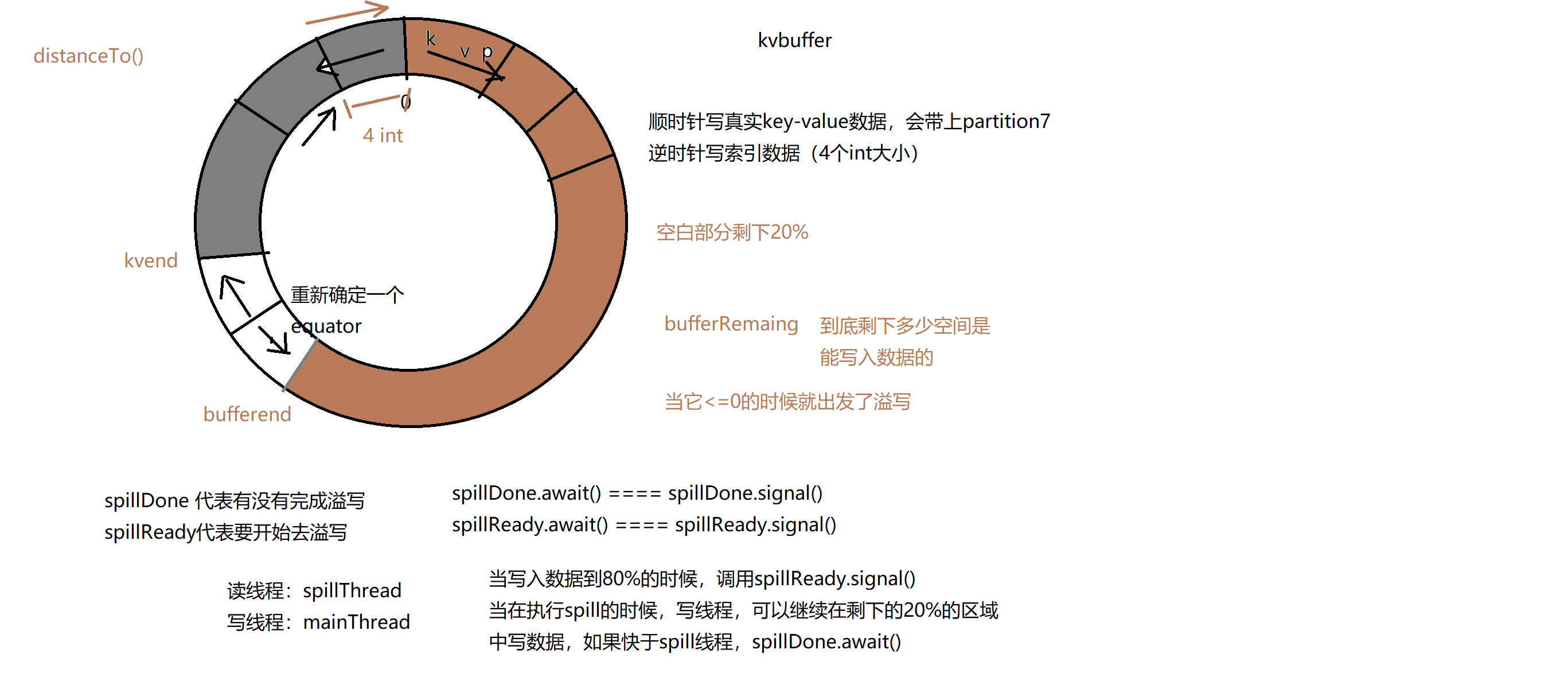
1.7 怎么溢写的
// start spill if the thread is not running and the soft limit has been
// reached
spillLock.lock();
try {
  do {
    if (!spillInProgress) {
      final int kvbidx = 4 * kvindex;
      final int kvbend = 4 * kvend;
      // serialized, unspilled bytes always lie between kvindex and
      // bufindex, crossing the equator. Note that any void space
      // created by a reset must be included in "used" bytes
      final int bUsed = distanceTo(kvbidx, bufindex);
      final boolean bufsoftlimit = bUsed >= softLimit;
      if ((kvbend + METASIZE) % kvbuffer.length !=
          equator - (equator % METASIZE)) {
        // spill finished, reclaim space
        resetSpill();
        bufferRemaining = Math.min(
            distanceTo(bufindex, kvbidx) - 2 * METASIZE,
            softLimit - bUsed) - METASIZE;
        continue;
      } else if (bufsoftlimit && kvindex != kvend) {
        // spill records, if any collected; check latter, as it may
        // be possible for metadata alignment to hit spill pcnt
        /**
         * 开始溢写
         */
        startSpill();
        final int avgRec = (int)
          (mapOutputByteCounter.getCounter() /
          mapOutputRecordCounter.getCounter());
        // leave at least half the split buffer for serialization data
        // ensure that kvindex >= bufindex
        final int distkvi = distanceTo(bufindex, kvbidx);
        /**
         * 既然满足了溢写条件,那么写数据线程,就只能继续往剩下的20)的区域中写数据
         * 但是需要重新溢写
         */
        final int newPos = (bufindex +
          Math.max(2 * METASIZE - 1,
                  Math.min(distkvi / 2,
                           distkvi / (METASIZE + avgRec) * METASIZE)))
          % kvbuffer.length;
        setEquator(newPos);
        bufmark = bufindex = newPos;
        final int serBound = 4 * kvend;
        // bytes remaining before the lock must be held and limits
        // checked is the minimum of three arcs: the metadata space, the
        // serialization space, and the soft limit
        bufferRemaining = Math.min(
            // metadata max
            distanceTo(bufend, newPos),
            Math.min(
              // serialization max
              distanceTo(newPos, serBound),
              // soft limit
              softLimit)) - 2 * METASIZE;
      }
    }
  } while (false);
1.7 startSpill
private void startSpill() {
  assert !spillInProgress;
  kvend = (kvindex + NMETA) % kvmeta.capacity();
  bufend = bufmark;
  spillInProgress = true;
  LOG.info("Spilling map output");
  LOG.info("bufstart = " + bufstart + "; bufend = " + bufmark +
           "; bufvoid = " + bufvoid);
  LOG.info("kvstart = " + kvstart + "(" + (kvstart * 4) +
           "); kvend = " + kvend + "(" + (kvend * 4) +
           "); length = " + (distanceTo(kvend, kvstart,
                 kvmeta.capacity()) + 1) + "/" + maxRec);
  spillReady.signal();
}
我们发现了spillReady.signal() 把溢写线程给唤醒了
1.8 SpillThread的run方法
/**
 * 关于 SplillThread:
 * 四个重要的组件:
 * 1. SpillThread sortAndSpill() startSpill()
 * 2. 可重入锁: ReentrantLock spillLock
 * 3. 信号变量: Condition spillDone
 * 4. 信号变量: Condition spillReady
 *
 * 再介绍两个重要的线程
 * 1. 写数据线程
 * 2. 一个spill线程
 *
 * 重要的工作机制
 * 1. 当 kvbuffer写满百分之80的时候,应该被锁定
 * 2. 写入数据线程,就应该重新确定 equ
 */
protected class SpillThread extends Thread {

  @Override
  public void run() {
    spillLock.lock();
    spillThreadRunning = true;
    try {
      while (true) {

        /**
         * TODO 让写入数据开始写数据
         * 告诉写数据线程 spill线程 溢写完毕
         */
        spillDone.signal();
        /**
         * TODO 一直在等待
         * 刚开始 默认是 false
         */
        while (!spillInProgress) {
          // 只有 当 写线程的时候,spillReady.signal() 然后才会继续往下执行
          spillReady.await();
        }
        try {
          spillLock.unlock();
          //TODO 现在已经卡在这里了
          // 执行溢写
          sortAndSpill();
        } catch (Throwable t) {
          sortSpillException = t;
        } finally {
          spillLock.lock();
          if (bufend < bufstart) {
            bufvoid = kvbuffer.length;
          }
          kvstart = kvend;
          bufstart = bufend;
          spillInProgress = false;
        }
      } //for结束
    } catch (InterruptedException e) {
      Thread.currentThread().interrupt();
    } finally {
      spillLock.unlock();
      spillThreadRunning = false;
    }
  }
}
1.9 sortAndSpill
private void sortAndSpill() throws IOException, ClassNotFoundException,
                                   InterruptedException {
  //approximate the length of the output file to be the length of the
  //buffer + header lengths for the partitions
  final long size = distanceTo(bufstart, bufend, bufvoid) +
              partitions * APPROX_HEADER_LENGTH;
  FSDataOutputStream out = null;
  try {
    // create spill file
    final SpillRecord spillRec = new SpillRecord(partitions);
    final Path filename =
        mapOutputFile.getSpillFileForWrite(numSpills, size);
    out = rfs.create(filename);

    final int mstart = kvend / NMETA;
    final int mend = 1 + // kvend is a valid record
      (kvstart >= kvend
      ? kvstart
      : kvmeta.capacity() + kvstart) / NMETA;
    //TODO sorter = QuickSort
    //TODO 对于将溢写数据,执行排序操作
    /**
     * 直接就在80% 的那个内存区域中,执行排序动作!
     * 排序过程中,就是执行不同位置上的数据的位置交换
     *
     * 内存区域中的所有数据就有序了
     * 1.先按照partiion 排序,相同分区的数据就在一起你了
     * 2. 在每个分区中,然后按照key进行排序
     *
     * this: 就是数据缓冲区
     */
    sorter.sort(MapOutputBuffer.this, mstart, mend, reporter);
    int spindex = mstart;
    final IndexRecord rec = new IndexRecord();
    final InMemValBytes value = new InMemValBytes();

    /**
     * TODO 遍历每个分区,写出真实数据,同时记录索引
     */
    for (int i = 0; i < partitions; ++i) {
      IFile.Writer<K, V> writer = null;
      try {
        long segmentStart = out.getPos();
        FSDataOutputStream partitionOut = CryptoUtils.wrapIfNecessary(job, out);
        /**
         * TODO 这个writer就是写出流
         */
        writer = new Writer<K, V>(job, partitionOut, keyClass, valClass, codec,
                                  spilledRecordsCounter);

        /**
         * TODO 开始判断是否执行combiner
         * combineCollector 这个
         */
        if (combinerRunner == null) {
          // spill directly
          DataInputBuffer key = new DataInputBuffer();
          while (spindex < mend &&
              kvmeta.get(offsetFor(spindex % maxRec) + PARTITION) == i) {
            final int kvoff = offsetFor(spindex % maxRec);
            int keystart = kvmeta.get(kvoff + KEYSTART);
            int valstart = kvmeta.get(kvoff + VALSTART);
            key.reset(kvbuffer, keystart, valstart - keystart);
            getVBytesForOffset(kvoff, value);
            /**
             * TODO 如果没有设置 combiner 就直接输出
             */
            writer.append(key, value);
            ++spindex;
          }
        } else {
          int spstart = spindex;
          while (spindex < mend &&
              kvmeta.get(offsetFor(spindex % maxRec)
                        + PARTITION) == i) {
            ++spindex;
          }
          // Note: we would like to avoid the combiner if we've fewer
          // than some threshold of records for a partition
          if (spstart != spindex) {
            combineCollector.setWriter(writer);
            RawKeyValueIterator kvIter =
              new MRResultIterator(spstart, spindex);
            /**
             * TODO 执行combiner 操作
             */
            combinerRunner.combine(kvIter, combineCollector);
          }
        }

        // close the writer
        writer.close();

        // record offsets
        rec.startOffset = segmentStart;
        rec.rawLength = writer.getRawLength() + CryptoUtils.cryptoPadding(job);
        rec.partLength = writer.getCompressedLength() + CryptoUtils.cryptoPadding(job);
        spillRec.putIndex(rec, i);

        writer = null;
      } finally {
        if (null != writer) writer.close();
      }
    }

    if (totalIndexCacheMemory >= indexCacheMemoryLimit) {
      // create spill index file
      Path indexFilename =
          mapOutputFile.getSpillIndexFileForWrite(numSpills, partitions
              * MAP_OUTPUT_INDEX_RECORD_LENGTH);
      spillRec.writeToFile(indexFilename, job);
    } else {
      indexCacheList.add(spillRec);
      totalIndexCacheMemory +=
        spillRec.size() * MAP_OUTPUT_INDEX_RECORD_LENGTH;
    }
    LOG.info("Finished spill " + numSpills);
    ++numSpills;
  } finally {
    if (out != null) out.close();
  }
}
1.10 执行合并 splill的操作
/**
 * TODO 执行合并 spill的操作
 *
 */
output.close(mapperContext);
1.11 close
  @Override
  public void close(TaskAttemptContext context
                    ) throws IOException,InterruptedException {
    try {
      /**
       * TODO  MapOutputBuffer 写出去
       */
      collector.flush();
    } catch (ClassNotFoundException cnf) {
      throw new IOException("can't find class ", cnf);
    }
    collector.close();
  }
}
1.12 collector.flush();
public void flush() throws IOException, ClassNotFoundException,
       InterruptedException {
  LOG.info("Starting flush of map output");
  if (kvbuffer == null) {
    LOG.info("kvbuffer is null. Skipping flush.");
    return;
  }
  spillLock.lock();
  try {
    while (spillInProgress) {
      reporter.progress();
      spillDone.await();
    }
    checkSpillException();

    final int kvbend = 4 * kvend;
    if ((kvbend + METASIZE) % kvbuffer.length !=
        equator - (equator % METASIZE)) {
      // spill finished
      resetSpill();
    }
    if (kvindex != kvend) {
      kvend = (kvindex + NMETA) % kvmeta.capacity();
      bufend = bufmark;
      LOG.info("Spilling map output");
      LOG.info("bufstart = " + bufstart + "; bufend = " + bufmark +
               "; bufvoid = " + bufvoid);
      LOG.info("kvstart = " + kvstart + "(" + (kvstart * 4) +
               "); kvend = " + kvend + "(" + (kvend * 4) +
               "); length = " + (distanceTo(kvend, kvstart,
                     kvmeta.capacity()) + 1) + "/" + maxRec);

      /**
       * 因为当所有的map方法执行完之后,有可能环形缓冲区汇总,还是有数据的,因为并没有触发溢写
       * 这个地方执行溢写,就是为了把 缓冲区中的剩余数据写出去 都溢写出来
       */
      sortAndSpill();
    }
  } catch (InterruptedException e) {
    throw new IOException("Interrupted while waiting for the writer", e);
  } finally {
    spillLock.unlock();
  }
  assert !spillLock.isHeldByCurrentThread();
  // shut down spill thread and wait for it to exit. Since the preceding
  // ensures that it is finished with its work (and sortAndSpill did not
  // throw), we elect to use an interrupt instead of setting a flag.
  // Spilling simultaneously from this thread while the spill thread
  // finishes its work might be both a useful way to extend this and also
  // sufficient motivation for the latter approach.
  try {
    spillThread.interrupt();
    spillThread.join();
  } catch (InterruptedException e) {
    throw new IOException("Spill failed", e);
  }
  // release sort buffer before the merge
  kvbuffer = null;

  /**
   * 所有的spill 文件执行合并操作
   */
  mergeParts();
  Path outputPath = mapOutputFile.getOutputFile();
  fileOutputByteCounter.increment(rfs.getFileStatus(outputPath).getLen());
}
1.13 mergeParts
private void mergeParts() throws IOException, InterruptedException,
                                 ClassNotFoundException {
  // get the approximate size of the final output/index files
  long finalOutFileSize = 0;
  long finalIndexFileSize = 0;
  //TODO numSpills 意思就是执行了多少次 溢写操作
  final Path[] filename = new Path[numSpills];
  final TaskAttemptID mapId = getTaskID();

  for(int i = 0; i < numSpills; i++) {
    filename[i] = mapOutputFile.getSpillFile(i);
    finalOutFileSize += rfs.getFileStatus(filename[i]).getLen();
  }
  /**
   * 如果你指一些了一次,那么就一个文件
   */
  if (numSpills == 1) { //the spill is the final output
    sameVolRename(filename[0],
        mapOutputFile.getOutputFileForWriteInVolume(filename[0]));
    if (indexCacheList.size() == 0) {
      sameVolRename(mapOutputFile.getSpillIndexFile(0),
        mapOutputFile.getOutputIndexFileForWriteInVolume(filename[0]));
    } else {
      indexCacheList.get(0).writeToFile(
        mapOutputFile.getOutputIndexFileForWriteInVolume(filename[0]), job);
    }
    sortPhase.complete();
    return;
  }

  // read in paged indices
  for (int i = indexCacheList.size(); i < numSpills; ++i) {
    Path indexFileName = mapOutputFile.getSpillIndexFile(i);
    indexCacheList.add(new SpillRecord(indexFileName, job));
  }

  //make correction in the length to include the sequence file header
  //lengths for each partition
  finalOutFileSize += partitions * APPROX_HEADER_LENGTH;
  finalIndexFileSize = partitions * MAP_OUTPUT_INDEX_RECORD_LENGTH;
  Path finalOutputFile =
      mapOutputFile.getOutputFileForWrite(finalOutFileSize);
  Path finalIndexFile =
      mapOutputFile.getOutputIndexFileForWrite(finalIndexFileSize);

  //The output stream for the final single output file
  FSDataOutputStream finalOut = rfs.create(finalOutputFile, true, 4096);

  /**
   * 如果 没有溢写文件
   * 之输出一个_success文件
   */
  if (numSpills == 0) {
    //create dummy files
    IndexRecord rec = new IndexRecord();
    SpillRecord sr = new SpillRecord(partitions);
    try {
      for (int i = 0; i < partitions; i++) {
        long segmentStart = finalOut.getPos();
        FSDataOutputStream finalPartitionOut = CryptoUtils.wrapIfNecessary(job, finalOut);
        Writer<K, V> writer =
          new Writer<K, V>(job, finalPartitionOut, keyClass, valClass, codec, null);
        writer.close();
        rec.startOffset = segmentStart;
        rec.rawLength = writer.getRawLength() + CryptoUtils.cryptoPadding(job);
        rec.partLength = writer.getCompressedLength() + CryptoUtils.cryptoPadding(job);
        sr.putIndex(rec, i);
      }
      sr.writeToFile(finalIndexFile, job);
    } finally {
      finalOut.close();
    }
    sortPhase.complete();
    return;
  }
  {
    sortPhase.addPhases(partitions); // Divide sort phase into sub-phases

    IndexRecord rec = new IndexRecord();
    final SpillRecord spillRec = new SpillRecord(partitions);

    /**
     * TODO 否则的话 就按照分区进行合并!
     * 1. 把每个spill文件的对应问去的数据都弄过来来进行合并 (mergeSort 归并排序)
     * 2. 为当前这个分区生成一条索引信息
     * 3. 如果所有的分区都合并完了,所有的分区的索引,就都被管理在spillRec对象汇总
     * 4. 再把这个spillRec 持久化到磁盘上
     *
     */
    for (int parts = 0; parts < partitions; parts++) {
      //create the segments to be merged
      List<Segment<K,V>> segmentList = new ArrayList<Segment<K, V>>(numSpills);
      for(int i = 0; i < numSpills; i++) {
        IndexRecord indexRecord = indexCacheList.get(i).getIndex(parts);
        //Segment  每一个溢写文件 每个文件的数据 就是一个 Segment
        Segment<K,V> s = new Segment<K,V>(job, rfs, filename[i], indexRecord.startOffset,
                           indexRecord.partLength, codec, true);
        segmentList.add(i, s);

        if (LOG.isDebugEnabled()) {
          LOG.debug("MapId=" + mapId + " Reducer=" + parts +
              "Spill =" + i + "(" + indexRecord.startOffset + "," +
              indexRecord.rawLength + ", " + indexRecord.partLength + ")");
        }
      }

      int mergeFactor = job.getInt(JobContext.IO_SORT_FACTOR, 100);
      // sort the segments only if there are intermediate merges
      boolean sortSegments = segmentList.size() > mergeFactor;
      //merge
      @SuppressWarnings("unchecked")
      RawKeyValueIterator kvIter = Merger.merge(job, rfs,
                     keyClass, valClass, codec,
                     segmentList, mergeFactor,
                     new Path(mapId.toString()),
                     job.getOutputKeyComparator(), reporter, sortSegments,
                     null, spilledRecordsCounter, sortPhase.phase(),
                     TaskType.MAP);

      //write merged output to disk
      long segmentStart = finalOut.getPos();
      FSDataOutputStream finalPartitionOut = CryptoUtils.wrapIfNecessary(job, finalOut);
      Writer<K, V> writer =
          new Writer<K, V>(job, finalPartitionOut, keyClass, valClass, codec,
                           spilledRecordsCounter);
      if (combinerRunner == null || numSpills < minSpillsForCombine) {
        Merger.writeFile(kvIter, writer, reporter, job);
      } else {
        combineCollector.setWriter(writer);
        combinerRunner.combine(kvIter, combineCollector);
      }

      //close
      writer.close();

      sortPhase.startNextPhase();

      /**
       * TODO 上面所有的spill文件都已经合并成一个 数据文件了
       * 同时也会给这个数据文件 生成一个索引文件
       */
      // record offsets
      rec.startOffset = segmentStart;
      rec.rawLength = writer.getRawLength() + CryptoUtils.cryptoPadding(job);
      rec.partLength = writer.getCompressedLength() + CryptoUtils.cryptoPadding(job);
      spillRec.putIndex(rec, parts);
    }
    /**
     * 将文件写出去
     */
    spillRec.writeToFile(finalIndexFile, job);
    finalOut.close();
    for(int i = 0; i < numSpills; i++) {
      rfs.delete(filename[i],true);
    }
  }
}
2. ReduceTask的工作原理
2.1 ReduceTask的run方法
public void run(JobConf job, final TaskUmbilicalProtocol umbilical)
  throws IOException, InterruptedException, ClassNotFoundException {
  job.setBoolean(JobContext.SKIP_RECORDS, isSkipping());

  /**
   * TODO copy + sort 就等于 shuffer
   * 1. 先拉取数据
   * 2. 然后使用归并排序的方式合并数据成一个文件
   * 3. 执行reduce操作
   */
  if (isMapOrReduce()) {
    copyPhase = getProgress().addPhase("copy");
    sortPhase  = getProgress().addPhase("sort");
    reducePhase = getProgress().addPhase("reduce");
  }
  // start thread that will handle communication with parent
  TaskReporter reporter = startReporter(umbilical);

  boolean useNewApi = job.getUseNewReducer();
  /**
   * TODO 这个地方的初始化,最重要,就是初始化了一个output
   */
  initialize(job, getJobID(), reporter, useNewApi);


  // check if it is a cleanupJobTask
  if (jobCleanup) {
    runJobCleanupTask(umbilical, reporter);
    return;
  }
  if (jobSetup) {
    runJobSetupTask(umbilical, reporter);
    return;
  }
  if (taskCleanup) {
    runTaskCleanupTask(umbilical, reporter);
    return;
  }

  // Initialize the codec
  codec = initCodec();
  RawKeyValueIterator rIter = null;

  /**
   * TODO reducer阶段负责拉取数据,和执行合并的事情,都是由ShuffleConsumerPlugin 这个组件来完成的
   */
  ShuffleConsumerPlugin shuffleConsumerPlugin = null;

  Class combinerClass = conf.getCombinerClass();
  CombineOutputCollector combineCollector =
    (null != combinerClass) ?
   new CombineOutputCollector(reduceCombineOutputCounter, reporter, conf) : null;

  Class<? extends ShuffleConsumerPlugin> clazz =
        job.getClass(MRConfig.SHUFFLE_CONSUMER_PLUGIN, Shuffle.class, ShuffleConsumerPlugin.class);

  shuffleConsumerPlugin = ReflectionUtils.newInstance(clazz, job);
  LOG.info("Using ShuffleConsumerPlugin: " + shuffleConsumerPlugin);

  ShuffleConsumerPlugin.Context shuffleContext =
    new ShuffleConsumerPlugin.Context(getTaskID(), job, FileSystem.getLocal(job), umbilical,
                super.lDirAlloc, reporter, codec,
                combinerClass, combineCollector,
                spilledRecordsCounter, reduceCombineInputCounter,
                shuffledMapsCounter,
                reduceShuffleBytes, failedShuffleCounter,
                mergedMapOutputsCounter,
                taskStatus, copyPhase, sortPhase, this,
                mapOutputFile, localMapFiles);

  /**
   * TODO 执行插件的初始化
   * 创建了两个重要的对象
   * 1. ShuffleSchedulerImpl
   * 2. MergeManager
   */
  shuffleConsumerPlugin.init(shuffleContext);

  /**
   * TODO 执行正儿八经的拉取数据和合并操作
   */
  rIter = shuffleConsumerPlugin.run();

  // free up the data structures
  mapOutputFilesOnDisk.clear();

  sortPhase.complete();                         // sort is complete
  setPhase(TaskStatus.Phase.REDUCE);
  statusUpdate(umbilical);
  Class keyClass = job.getMapOutputKeyClass();
  Class valueClass = job.getMapOutputValueClass();
  RawComparator comparator = job.getOutputValueGroupingComparator();

  if (useNewApi) {
    /**
     * TODO 新API
     */
    runNewReducer(job, umbilical, reporter, rIter, comparator,
                  keyClass, valueClass);
  } else {
    runOldReducer(job, umbilical, reporter, rIter, comparator,
                  keyClass, valueClass);
  }

  shuffleConsumerPlugin.close();
  done(umbilical, reporter);
}
2.2 shuffleConsumerPlugin.init(shuffleContext);
public void init(ShuffleConsumerPlugin.Context context) {
  this.context = context;

  this.reduceId = context.getReduceId();
  this.jobConf = context.getJobConf();
  this.umbilical = context.getUmbilical();
  this.reporter = context.getReporter();
  this.metrics = new ShuffleClientMetrics(reduceId, jobConf);
  this.copyPhase = context.getCopyPhase();
  this.taskStatus = context.getStatus();
  this.reduceTask = context.getReduceTask();
  this.localMapFiles = context.getLocalMapFiles();

  /**
   * TODO ShuffleSchedulerImpl 负责拉取数据的
   */
  scheduler = new ShuffleSchedulerImpl<K, V>(jobConf, taskStatus, reduceId,
      this, copyPhase, context.getShuffledMapsCounter(),
      context.getReduceShuffleBytes(), context.getFailedShuffleCounter());
  /**
   * TODO 负责执行合并的
   */
  merger = createMergeManager(context);
}
2.3 shuffleConsumerPlugin.run();
/**
 * TODO : EventFetcher 是一个总的管理对象!
 *  会按照参数设置: 每个reduceTask会初始化5个Fetcher线程执行拉取数据操作
 * @return
 * @throws IOException
 * @throws InterruptedException
 */
@Override
public RawKeyValueIterator run() throws IOException, InterruptedException {
  // Scale the maximum events we fetch per RPC call to mitigate OOM issues
  // on the ApplicationMaster when a thundering herd of reducers fetch events
  // TODO: This should not be necessary after HADOOP-8942
  int eventsPerReducer = Math.max(MIN_EVENTS_TO_FETCH,
      MAX_RPC_OUTSTANDING_EVENTS / jobConf.getNumReduceTasks());
  int maxEventsToFetch = Math.min(MAX_EVENTS_TO_FETCH, eventsPerReducer);

  // Start the map-completion events fetcher thread
  final EventFetcher<K,V> eventFetcher =
    new EventFetcher<K,V>(reduceId, umbilical, scheduler, this,
        maxEventsToFetch);
  eventFetcher.start();

  // Start the map-output fetcher threads
  boolean isLocal = localMapFiles != null;

  final int numFetchers = isLocal ? 1 : jobConf.getInt(MRJobConfig.SHUFFLE_PARALLEL_COPIES, 5);

  /**
   * TODO 启动numFetchers的 拉取数据的线程
   *  拉取所使用的的方式: HTTP协议
   *  内部在工作的时候:
   *  1. 每个mapTask(NodeManager) 在执行完毕的时候,就会向MRAppmatser汇报
   *  执行汇报的时候:这个NodeManager 就会告诉 这个mapTask 执行完毕的结果存放在哪里,当前这个maptask执行节点的
   *  hostname:port
   *  2. NodeManager 会向ResourceManager
   *  3. MRAppMaster 启动 reduceTask 同时告诉这些reduceTask已经完成了的mapTask有哪些
   *    所以这些reduceTask 就可以提前启动,然后去已经完成了的maptask节点去拉取数据,做提前合并
   *  4. 每个reduceTask去mapTask拉取数据的时候,都会先扫描索引文件,确定自己的分区的数据范围
   *  5. 通过HTTP的方式吧数据传输
   */
  Fetcher<K,V>[] fetchers = new Fetcher[numFetchers];
  if (isLocal) {
    fetchers[0] = new LocalFetcher<K, V>(jobConf, reduceId, scheduler,
        merger, reporter, metrics, this, reduceTask.getShuffleSecret(),
        localMapFiles);
    fetchers[0].start();
  } else {
    for (int i=0; i < numFetchers; ++i) {
      /**
       * TODO 启动fetcher线程
       */
      fetchers[i] = new Fetcher<K,V>(jobConf, reduceId, scheduler, merger,
                                     reporter, metrics, this,
                                     reduceTask.getShuffleSecret());
      fetchers[i].start();
    }
  }


  // Wait for shuffle to complete successfully
  /**
   * 当fetcher把所有数据都取到之后,开始执行
   */
  while (!scheduler.waitUntilDone(PROGRESS_FREQUENCY)) {
    reporter.progress();

    synchronized (this) {
      if (throwable != null) {
        throw new ShuffleError("error in shuffle in " + throwingThreadName,
                               throwable);
      }
    }
  }

  // Stop the event-fetcher thread
  eventFetcher.shutDown();

  // Stop the map-output fetcher threads
  for (Fetcher<K,V> fetcher : fetchers) {
    fetcher.shutDown();
  }

  // stop the scheduler
  scheduler.close();

  copyPhase.complete(); // copy is already complete
  taskStatus.setPhase(TaskStatus.Phase.SORT);
  reduceTask.statusUpdate(umbilical);

  // Finish the on-going merges...
  RawKeyValueIterator kvIter = null;
  try {
    /**
     * TODO
     */
    kvIter = merger.close();
  } catch (Throwable e) {
    throw new ShuffleError("Error while doing final merge " , e);
  }

  // Sanity check
  synchronized (this) {
    if (throwable != null) {
      throw new ShuffleError("error in shuffle in " + throwingThreadName,
                             throwable);
    }
  }

  return kvIter;
}
2.4 runNewReducer
@SuppressWarnings("unchecked")
private <INKEY,INVALUE,OUTKEY,OUTVALUE>
void runNewReducer(JobConf job,
                   final TaskUmbilicalProtocol umbilical,
                   final TaskReporter reporter,
                   RawKeyValueIterator rIter,
                   RawComparator<INKEY> comparator,
                   Class<INKEY> keyClass,
                   Class<INVALUE> valueClass
                   ) throws IOException,InterruptedException,
                            ClassNotFoundException {
  // wrap value iterator to report progress.
  final RawKeyValueIterator rawIter = rIter;
  rIter = new RawKeyValueIterator() {
    public void close() throws IOException {
      rawIter.close();
    }
    public DataInputBuffer getKey() throws IOException {
      return rawIter.getKey();
    }
    public Progress getProgress() {
      return rawIter.getProgress();
    }
    public DataInputBuffer getValue() throws IOException {
      return rawIter.getValue();
    }
    public boolean next() throws IOException {
      boolean ret = rawIter.next();
      reporter.setProgress(rawIter.getProgress().getProgress());
      return ret;
    }
  };
  // make a task context so we can get the classes
  org.apache.hadoop.mapreduce.TaskAttemptContext taskContext =
    new org.apache.hadoop.mapreduce.task.TaskAttemptContextImpl(job,
        getTaskID(), reporter);
  // make a reducer
  org.apache.hadoop.mapreduce.Reducer<INKEY,INVALUE,OUTKEY,OUTVALUE> reducer =
    (org.apache.hadoop.mapreduce.Reducer<INKEY,INVALUE,OUTKEY,OUTVALUE>)
      ReflectionUtils.newInstance(taskContext.getReducerClass(), job);
  org.apache.hadoop.mapreduce.RecordWriter<OUTKEY,OUTVALUE> trackedRW =
    new NewTrackingRecordWriter<OUTKEY, OUTVALUE>(this, taskContext);
  job.setBoolean("mapred.skip.on", isSkipping());
  job.setBoolean(JobContext.SKIP_RECORDS, isSkipping());
  org.apache.hadoop.mapreduce.Reducer.Context
       reducerContext = createReduceContext(reducer, job, getTaskID(),
                                             rIter, reduceInputKeyCounter,
                                             reduceInputValueCounter,
                                             trackedRW,
                                             committer,
                                             reporter, comparator, keyClass,
                                             valueClass);
  try {
    /**
     * TODO
     * reducer 就是你在写MR程序的shihou,自己定义的Reducer 类的 一个实例对象
     */
    reducer.run(reducerContext);
  } finally {
    trackedRW.close(reducerContext);
  }
}
2.5 run
/**
 * Advanced application writers can use the
 * {@link #run(org.apache.hadoop.mapreduce.Reducer.Context)} method to
 * control how the reduce task works.
 */
public void run(Context context) throws IOException, InterruptedException {
  setup(context);
  try {

    /**
     * TODO 三个重要的方法
     * context.nextKey() : 负责帮你读取key相同的一组数据,从上一步骤拉取数据和合并成为的最终大磁盘文件汇总扫描得到的
     * context.getCurrentKey(): 获取key,这个key 也会尽心个更改
     * context.getValues(): 当前这个key所对应的一组value
     *
     */
    while (context.nextKey()) {
      reduce(context.getCurrentKey(), context.getValues(), context);
      // If a back up store is used, reset it
      Iterator<VALUEIN> iter = context.getValues().iterator();
      if(iter instanceof ReduceContext.ValueIterator) {
        ((ReduceContext.ValueIterator<VALUEIN>)iter).resetBackupStore();
      }
    }
  } finally {
    cleanup(context);
  }
}
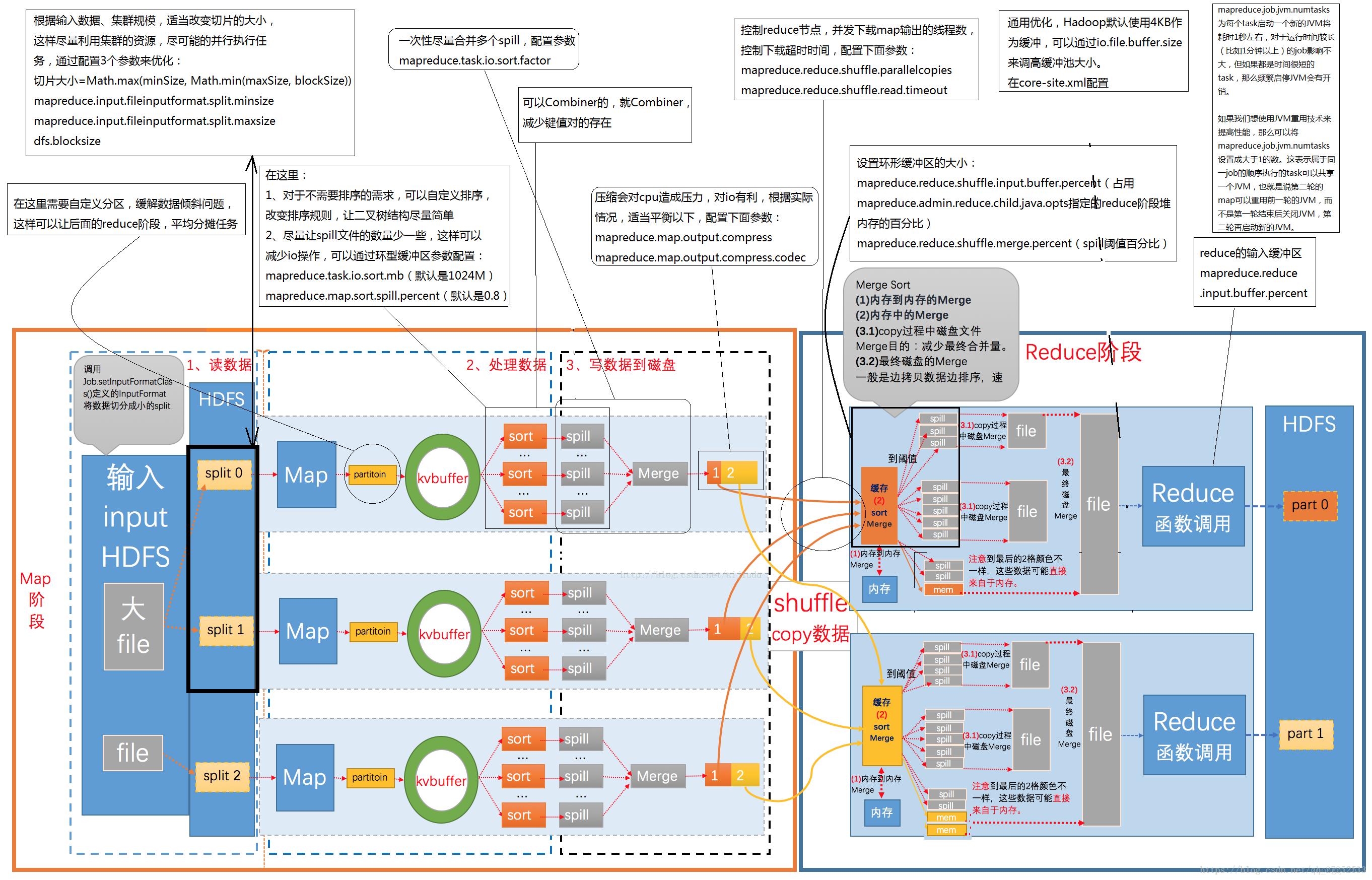
3. 总结

立足具身智能前沿赛道,致力于搭建全球化、开源化、全栈式技术交流与实践共创平台。
更多推荐
 0
0 0
0- 0


 已为社区贡献3条内容

所有评论(0)